
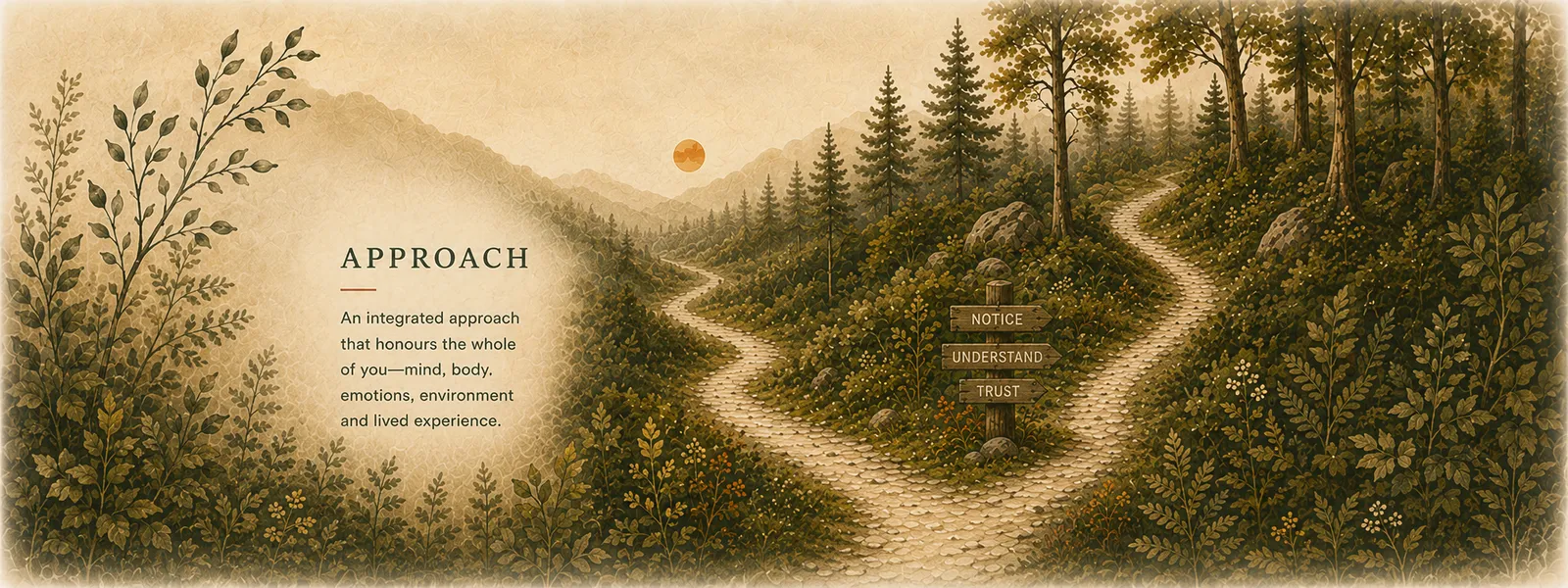
An ecological view of distress
Divergent Therapy begins with an ecological view of distress.
This means looking at a person within the wider ecology of their life: their body, nervous system, relationships, family systems, culture, work, education, environment, history, identity, responsibilities and repeated patterns.
This approach is concerned with the lived interface between a person and their context: the place where inner experience meets the relationships, systems, environments and expectations a person has had to live within.
Rather than asking only, “What is wrong with me?”, this approach also asks:
- What conditions have I had to adapt to?
- What parts of myself have I had to hide, soften, exaggerate or silence?
- What has my body and nervous system been trying to protect me from?
- Where have I been supported, and where have I been repeatedly misrecognised?
- What ways of living have helped me survive, but may no longer help me live?
From this perspective, distress is not dismissed or romanticised. It is taken seriously as a signal that something needs attention.
Sometimes that attention belongs inside the person: to their grief, fear, exhaustion, overwhelm, trauma responses, sensory needs, body signals or emotional pain.
Sometimes it belongs around the person: to the roles, systems, relationships, environments and expectations they have been living within.
Often, it belongs at the interface between the two.
Beyond either/or thinking
Many people feel caught between opposites.
They may feel capable and exhausted, connected and overwhelmed, masked and authentic, coping and close to collapse. For some people, these shifts can happen with little warning, moving rapidly between states that appear contradictory from the outside but make sense in the context of their circumstances, capacity and environment.
They may appear to be functioning from the outside while internally working far harder than others can see.
Divergent Therapy is interested in what happens between these apparent opposites.
- What conditions support regulation?
- What conditions increase strain?
- What gets missed before distress becomes visible?
- What early signals have been overridden, invalidated or hidden?
This matters because many people only recognise distress once it has tipped into overwhelm, shutdown, withdrawal, exhaustion or crisis.
The quieter middle can be harder to name: the point where effort is increasing, capacity is narrowing, needs are emerging, but the person is still managing to appear “fine”.
Therapeutic work can help make this middle more visible. It can support people to notice thresholds earlier, recognise what their body and nervous system are signalling, and understand what conditions help them remain connected, regulated and more fully themselves.
Living against yourself
Many people are seeking clarity after a long period of living in ways that have required them to override themselves.
This might mean pushing through exhaustion, ignoring sensory discomfort, hiding distress, performing competence, suppressing anger, minimising needs, staying in roles that no longer fit, or adapting so well to other people’s expectations that their own preferences, limits and desires become harder to hear.
Often, these adaptations began for good reasons.
They may have helped a person stay safe, belong, succeed, avoid conflict, maintain relationships, get through education or work, or survive environments where there was little room for their natural way of functioning.
The problem is not that these strategies existed.
The problem is that they can become costly when they are no longer chosen freely, or when they continue long after the original danger, demand or expectation has passed.
Over time, living against yourself can show up as burnout, shutdown, disconnection, resentment, anxiety, grief, numbness, loss of identity, or a sense of being unable to keep functioning in the way you once did.
This work can offer space to notice what has been adapted around, what has been carried for too long, and what parts of life may need to be reorganised around greater authenticity, safety, rhythm and fit.
Masking is not a failure of authenticity.
Masking is often spoken about in relation to neurodivergence, especially autism and ADHD, but it can be understood more broadly too.
Many people learn to hide, soften, exaggerate, perform or suppress parts of themselves in order to stay safe, belong, succeed or avoid harm.
This might involve masking neurodivergence, intelligence, sensitivity, grief, sexuality, gender, cultural identity, racialised experience, class, need, anger, exhaustion or difference.
Masking is not a failure of authenticity.
It is an intelligent and often necessary adaptation to environments that are unsafe, misattuned, punitive, or not built with a person’s needs in mind.
However, when masking becomes chronic, automatic or disconnected from choice, it can become costly.
A person may begin to lose contact with what they feel, need, prefer, notice or know. They may become skilled at appearing fine, to others as well as themselves, while moving further away from their own internal signals.
For this reason, unmasking is not treated here as a simple or universal goal.
It is not always safe, possible or desirable to become more visible in every context.
Sometimes the work is about developing more awareness, choice and flexibility: noticing where masking protects, where it harms, where it has become automatic, and where more authentic ways of being may be possible.
A therapeutic space can allow these questions to be explored slowly, with attention to safety, context, grief, agency and timing, while experimenting with what it might mean to become less masked with yourself and with safe others.
Neurodivergence and neuro-curiosity
Divergent Therapy has roots in neurodivergent experience, research and lived understanding.
This includes people who are diagnosed, self-identifying, questioning, late-recognised, or wondering whether neurodivergence may help explain parts of their experience.
It also includes people who may not identify as neurodivergent, but are curious about how they process the world, regulate, connect, feel and recover.
I think of this as neuro-curiosity: an openness to exploring the particular shape of a person’s mind, body, nervous system and way of moving through the world.
This is not about forcing people into labels.
A diagnosis can be meaningful, clarifying and validating for some people. For others, the work may be less about naming an identity and more about understanding patterns:
- What drains them
- What supports them
- What environments fit
- What relationships feel safe
- What expectations create strain
- What ways of functioning have been misunderstood
For some people, therapy may include exploring a label they already identify with and what it means in the context of their life, relationships and sense of self.
For others, it may involve thinking about whether to seek assessment, preparing for a diagnostic process, or making sense of one they have already been through.
A diagnosis or report can bring relief, grief, validation, belonging, confusion, frustration or a sense of “now what?”
It may explain a great deal but still leave a person wondering what it means for everyday life: work, rest, relationships, sensory needs, boundaries, masking, communication, support, identity and self-trust.
A supportive therapeutic relationship can help unpack this slowly, connecting the words on a report with the lived reality of being a person.
A neuro-affirming approach does not treat neurodivergence as a broken version of normal.
It asks what becomes possible when a person’s natural way of processing, sensing, feeling, communicating and engaging is understood with more accuracy, respect and context.
The aim is not to decide who belongs in which category, but to support deeper self-understanding, greater self-trust, and more sustainable ways of living.
Nature as scaffold
When a person has spent years overriding themselves, it can be difficult to know what they feel, need, want or prefer.
Internal signals may be faint, confusing, mistrusted, or only noticed once they become impossible to ignore.
Tiredness may only be recognised as collapse.
Overwhelm may only be recognised as shutdown.
Grief may only be recognised once it has become numbness, anger or exhaustion.
In this context, being told to “listen to your body” can feel unhelpful, frustrating or even impossible.
Divergent Therapy is interested in how nature and seasonal rhythms can offer an external scaffold while internal rhythm is slowly recovered.
Nature does not ask for constant productivity. It does not treat rest as failure, slowness as weakness, darkness as absence, or change as inconsistency.
It shows cycles of emergence, expansion, harvest, shedding, rest and return.
For people who have lived for a long time through masking, adaptation, trauma, burnout or disconnection, these external rhythms can offer a way back into noticing. They can provide language, permission and structure while a person slowly begins to recognise their own signals again.
This is not about nature as a cure.
Seasonal therapy and the Wheel of the Year
Seasonal work is not about forcing meaning onto nature.
It is about paying attention to cycles that are already present: emergence, expansion, harvest, release, rest and return.
The Wheel of the Year offers one way of noticing these changes. It can provide a loose seasonal map for reflection, helping people explore what is growing, what is ending, what needs tending, what needs protection, and what may need to be left alone for a while.
For people processing loss, or finding their way through burnout, trauma, masking or long-term adaptation, this can be especially important.
Many people have learned to live as though they should be constantly available, productive, responsive and improving.
But no living system exists in permanent growth, nor can it survive an endless summer.
We may all benefit from quieter times of incubation, where experience can be digested, composted, and slowly become fertile ground for whatever is ready to emerge next.
Seasonal therapy makes space for different kinds of timing.
There may be times for emergence and action, and times for retreat and integration. There may be times to become more visible, and times to become less available. There may be times to gather energy, and times to let something end.
This approach does not ask a person to follow the seasons rigidly.
It simply invites curiosity about rhythm, timing and fit.
You might ask yourself:
- What season am I in?
- What is being asked of me?
- What am I ready for?
- What am I forcing?
- What would support me now?
In this way, seasonal work can become a gentle structure for reconnecting with natural rhythm, self-trust and a more sustainable way of living.
Returning to rhythm
The aim of this work is not to become a more acceptable, productive or polished version of yourself.
It is to begin noticing what has been overridden, what has been adapted around, what has been silenced, and what may now be ready to surface, be heard, and be trusted again.
Returning to rhythm does not mean finding one fixed way of being and staying there.
Living systems change. Needs shift. Capacity rises and falls. Energy, grief, attention, connection, rest, desire and hormonal rhythms all move. For some people, menstrual cycles, perimenopause, menopause, hormones, illness, medication or other body rhythms may also shape what is possible at different times.
The work is therefore not about perfect consistency but about developing a more responsive relationship with yourself.
This might involve recognising early signs of strain, creating more supportive conditions, allowing rest before collapse, questioning expectations that no longer fit, experimenting with less masked ways of being, or learning what safety, belonging and authenticity feel like in practice.
Over time, this work can support a person to build a life with less unnecessary friction: a life shaped less by constant adaptation and more by self-trust, context, rhythm, relationship and fit.
Where this work sits: roots and neighbouring ideas
Some parts of Divergent Therapy have emerged through lived experience, therapeutic practice, research, observation and writing before I fully knew which wider fields they belonged beside.
As the work has developed, I have begun to recognise several neighbouring traditions and areas of research: ecopsychology, ecotherapy, nature-based therapy, seasonal and eco-psychotherapeutic practice, neuro-affirming therapy, masking research, burnout research, and work around environmental fit.
I do not see Divergent Therapy as separate from these roots.
At the same time, my own interest has taken a particular shape: the relationship between neurodivergent burnout, masking, seasonal rhythm, hidden thresholds, biodiversity, monoculture, self-trust, and the wider ecology around distress.
This section will gradually gather plain-language summaries of related ideas and research, not to claim ownership over what already exists, but to make the wider landscape easier to see.